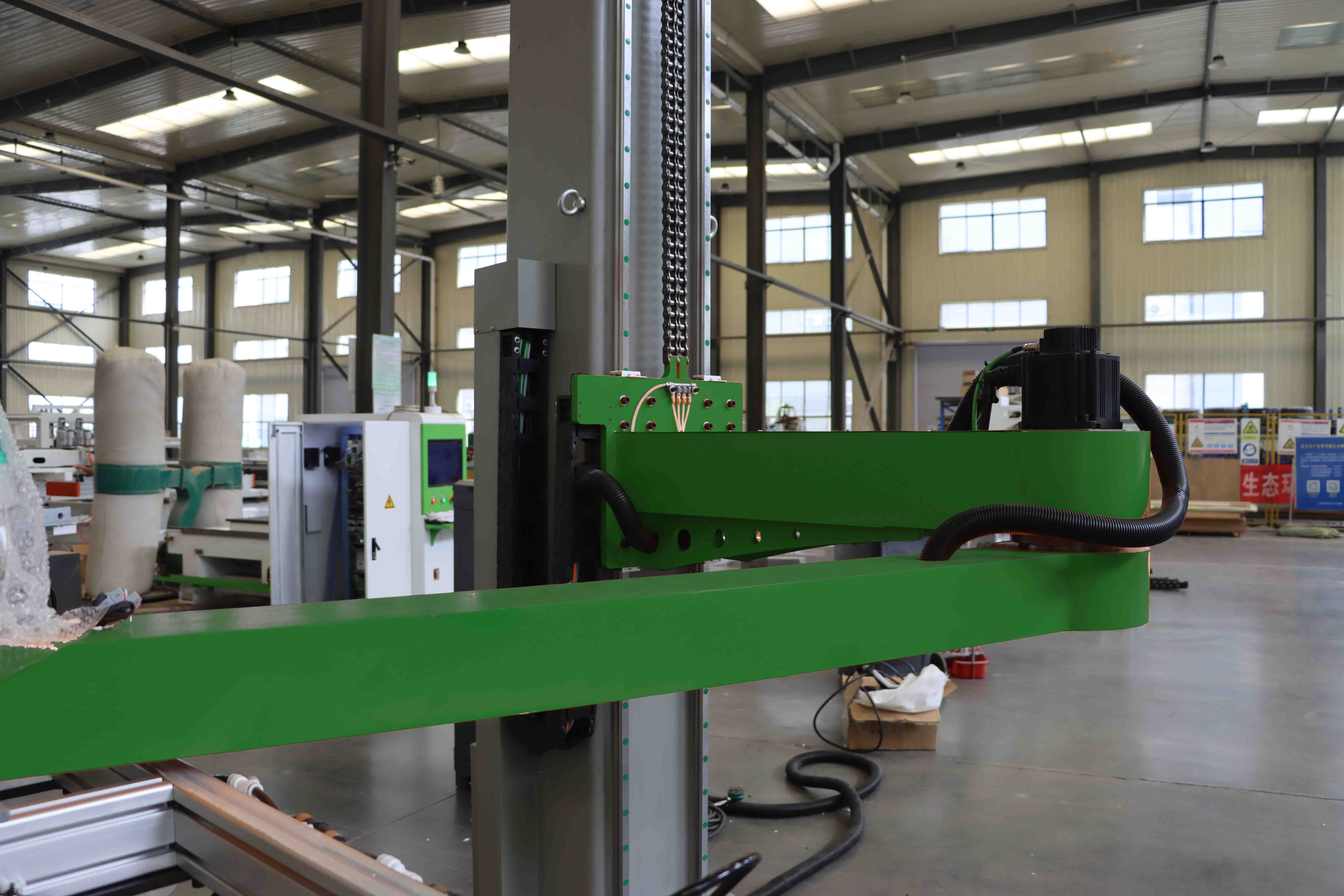
Abstract
In industrial CNC machining, few specifications are as consistently misunderstood as machine weight. Lighter is rarely better, and heavier is seldom a design flaw. This article examines the engineering rationale behind machine mass in CNC routers, woodworking machining centers, and stone carving systems. Drawing on structural dynamics, thermal stability, and vibration damping principles, we argue that machine weight is not a secondary specification but a primary determinant of precision, longevity, and process capability. Data from global market trends and comparative analysis of machine classes is presented, alongside a case study of ROCLAS® MACHINERY CO., LTD., whose heavy-duty gantry designs exemplify the industrial-grade approach to mass-enabled accuracy.
1. Introduction: The Misunderstood Metric
When procurement teams evaluate CNC equipment, power ratings, spindle speeds, and control systems often dominate the discussion. Yet experienced shop floor managers know that a machine’s weight—its total mass including the bed, gantry, columns, and base—correlates more directly with long-term performance than almost any other single parameter.
The reason lies in physics. Machining is a dynamic process: cutting forces, spindle vibrations, and workpiece reactions generate complex load paths through the machine structure. A lightweight frame, regardless of how stiff its material, will deflect under load, resonate at lower frequencies, and transmit vibrations into the cutting zone. Conversely, a heavy, well-damped structure absorbs these forces, maintaining tool-workpiece registration within microns.
For stone carving—where diamond tooling encounters granite, marble, and quartzite with compressive strengths exceeding 200 MPa—machine weight becomes non-negotiable. Similarly, in nested-based woodworking production, where high-speed routers traverse large workpieces at accelerations exceeding 1G, structural mass prevents chatter and ensures edge quality.
2. Market Data: Weight as a Market Segmentation Factor
The following table presents estimated global shipment data for CNC routers and machining centers across three weight classes, based on aggregated industry reports and trade association data for 2023.
| Machine Weight Class | Typical Applications | Average Ship Weight (kg) | Global Units Shipped (2023 est.) | Average Unit Price (USD) | Market Share (%) |
|----------------------|---------------------|--------------------------|----------------------------------|--------------------------|------------------|
| Light-Duty (< 1,500 kg) | Hobby, sign making, softwood nesting | 1,100 | 38,500 | $8,200 | 47% |
| Mid-Range (1,500–4,500 kg) | Cabinet production, aluminum machining, stone engraving | 2,900 | 24,000 | $24,500 | 29% |
| Heavy-Duty (> 4,500 kg) | Stone carving, mold making, heavy plate cutting, 5-axis | 7,200 | 19,800 | $62,000 | 24% |
Table 1: CNC Router and Machining Center Shipments by Weight Class, 2023 (estimated global data).
Analysis of Table Data
The data reveals a market where light-duty machines dominate unit volume but contribute only a fraction of total revenue. Mid-range and heavy-duty machines, despite fewer units, command significantly higher prices—a reflection of their structural complexity, material costs, and precision capability.
Notably, the heavy-duty segment shows the strongest growth trajectory (not shown in the static table but available in trend data), driven by expanding applications in architectural stonework, aerospace composites, and large-format mold fabrication. These applications demand not only spindle power but structural rigidity that only mass can provide.
The weight-to-price ratio is instructive: heavy-duty machines cost approximately $8.60 per kg, while light-duty units cost about $7.45 per kg. The premium reflects not just more steel but higher-grade cast iron, thicker weldments, precision-ground guide rails, and larger servomotors—all elements that require a robust, massive foundation.
3. The Engineering of Mass: Why Heavy Machines Cut Better
3.1 Vibration Damping and Chatter Suppression
In machining, regenerative chatter—the self-excited vibration between tool and workpiece—is the primary limitation on material removal rate and surface finish. Chatter occurs when the cutting force excites a structural natural frequency, causing the tool to oscillate and leave a wavy surface that reinforces the vibration.
A heavier machine has two advantages. First, its natural frequencies are lower (mass reduces frequency proportionally to √(k/m)), moving them away from typical spindle speeds and tooth-pass frequencies. Second, the damping ratio—the ability to dissipate vibrational energy—increases with mass, particularly in structures using cast iron or polymer concrete fillings.
For stone carving, where diamond tooling generates high-frequency impacts, the difference is