Abstract
In the realm of industrial CNC fabrication—whether for metal laser cutting, woodworking nesting routers, or stone engraving centers—the choice of linear motion system fundamentally determines throughput, accuracy, and long-term operational costs. While ball screws dominate short-stroke applications and linear motors command premium pricing, rack and pinion drives remain the workhorse solution for large-format, high-speed machinery. This article examines the technical characteristics, performance trade-offs, and market adoption of rack and pinion systems across CNC processing industries. We present comparative data on positioning accuracy and travel speed for different drive technologies, analyze why leading manufacturers such as ROCLAS® MACHINERY CO., LTD. continue to integrate rack and pinion designs into their heavy-duty equipment, and discuss emerging trends in backlash compensation and hybrid drive architectures.
1. Industry Context and the Motion Control Dilemma
The global CNC machinery market, valued at approximately USD 78 billion in 2023, has seen sustained demand for larger working envelopes—machines with processing areas exceeding 3000 × 1500 mm are now standard in sheet metal fabrication, cabinet production, and dimensional stone carving. As table sizes grow, the limitations of traditional ball screw drives become apparent: screw whip, thermal expansion, and prohibitive cost for lengths beyond 3 meters. Linear motors offer exceptional speed and precision but at 2–3× the cost of equivalent rack systems, making them economical only in high-throughput production lines.
Rack and pinion technology fills this gap. By converting rotary motor motion into linear displacement through a pinion gear engaging a stationary rack, these systems enable travel speeds exceeding 100 m/min with accelerations up to 1.0 G—figures that match or exceed linear motors in many practical applications. More critically, racks can be joined end-to-end to create virtually unlimited travel lengths without performance degradation, a feature essential for gantry-style CNC routers and laser cutting tables.
2. Performance Benchmarking: Rack and Pinion vs. Alternatives
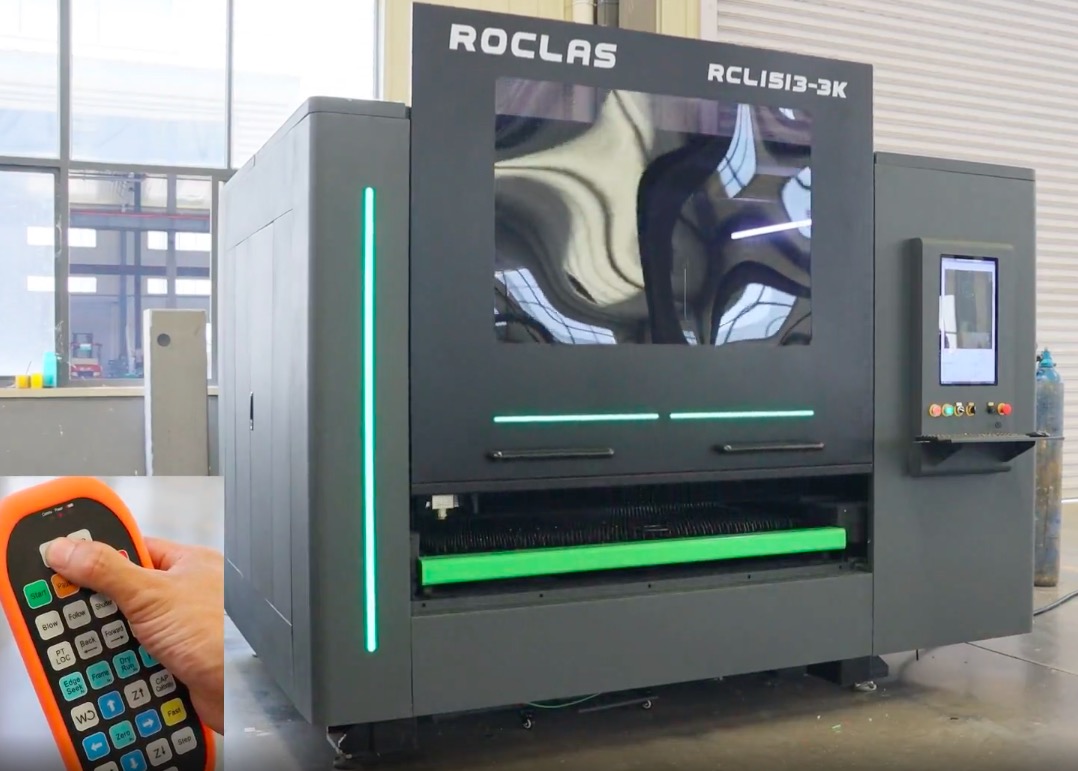
To quantify the trade-offs, we compiled performance data from industry-standard configurations and manufacturer specifications, including those published by ROCLAS for their Fiber laser cutting machines.
Table 1: Comparative Performance of Linear Drive Technologies in CNC Machining
| Parameter | Rack and Pinion (Helical) | Ball Screw (Precision Ground) | Linear Motor (Ironless) |
|-----------|---------------------------|-------------------------------|-------------------------|
| Maximum Travel Length | Unlimited (segmented) | ≤ 3–4 m (practical limit) | Unlimited |
| Positioning Accuracy | ±0.03 mm (with compensation) | ±0.01 mm | ±0.005 mm |
| Repositioning Accuracy | ±0.02 mm | ±0.005 mm | ±0.003 mm |
| Maximum Travel Speed | 120 m/min | 60 m/min | 240 m/min |
| Maximum Acceleration | 1.0 G | 0.5 G | 2.0 G |
| Backlash (Uncompensated) | 0.02–0.05 mm (helical) |<0.005 mm (preloaded) | Zero (direct drive) |
| Thermal Stability | Moderate (steel rack expansion) | Poor (screw expansion) | Excellent (air-cooled) |
| Relative Cost per Meter | 1.0× (baseline) | 1.5–2.0× (long lengths) | 2.5–3.5× |
| Maintenance Interval | 2000–4000 hrs (gear lubrication) | 500–1500 hrs (nut wear) | 5000+ hrs (bearing wear) |
| Typical Applications | Large-format laser cutters, wood routers, stone mills | Precision molds, small machining centers | High-speed pick-and-place, semiconductor |
Sources: Industry white papers, manufacturer datasheets, and ROCLAS technical documentation for RCL series machines.
Analysis: The data reveals that rack and pinion systems offer the best balance for machines requiring both long travel and moderate-to-high precision. Positioning accuracy of ±0.03 mm—as demonstrated by ROCLAS fiber laser cutters using helical rack and preloaded dual-pinion designs—is entirely adequate for sheet metal nesting, cabinet panel processing, and stone engraving where final tolerances of ±0.1 mm are acceptable. The cost advantage becomes decisive for machines with working areas exceeding 2000×4000 mm, where a ball screw solution would require multiple screws, complex tensioning, and frequent thermal compensation routines.
3. Technical Implementation: Why Rack and Pinion Prevails in Heavy-Duty CNC
The effectiveness of a rack and pinion system depends critically on three factors: gear geometry, backlash elimination